Inside TRIUMF’s Advanced Rare IsotopE Laboratory (ARIEL): World-Leading Rare Isotope Lab with Advanced Remote Handling and Radiation Safety
At TRIUMF, Canada’s particle accelerator centre, researchers and engineers are leveraging a suite of high-powered particle accelerators to produce world-leading quantities of critical isotopes safely and efficiently for science, medicine, and business.
TRIUMF is bringing online a new, $200M flagship facility, the Advanced Rare IsotopE Laboratory (ARIEL), which will triple the centre’s isotope output. ARIEL, as one of the only purpose-built rare isotope facilities in the world, as well as the world’s most powerful isotope separation online (ISOL) complex, has posed a variety of challenges, as well as opportunities for innovation. It features:
- a built-in-Canada superconducting electron linear accelerator for isotope production;
- a custom-built rare isotope beam transport system, designed, built, and installed by TRIUMF; and
- a special in-house recipe for concrete that can serve as both structural support and a shield for high-radiation environments within the building.
ARIEL also presented opportunities for international collaborations for multiple projects, including the front end (the portion of the target module that houses the hermetic target vessel).
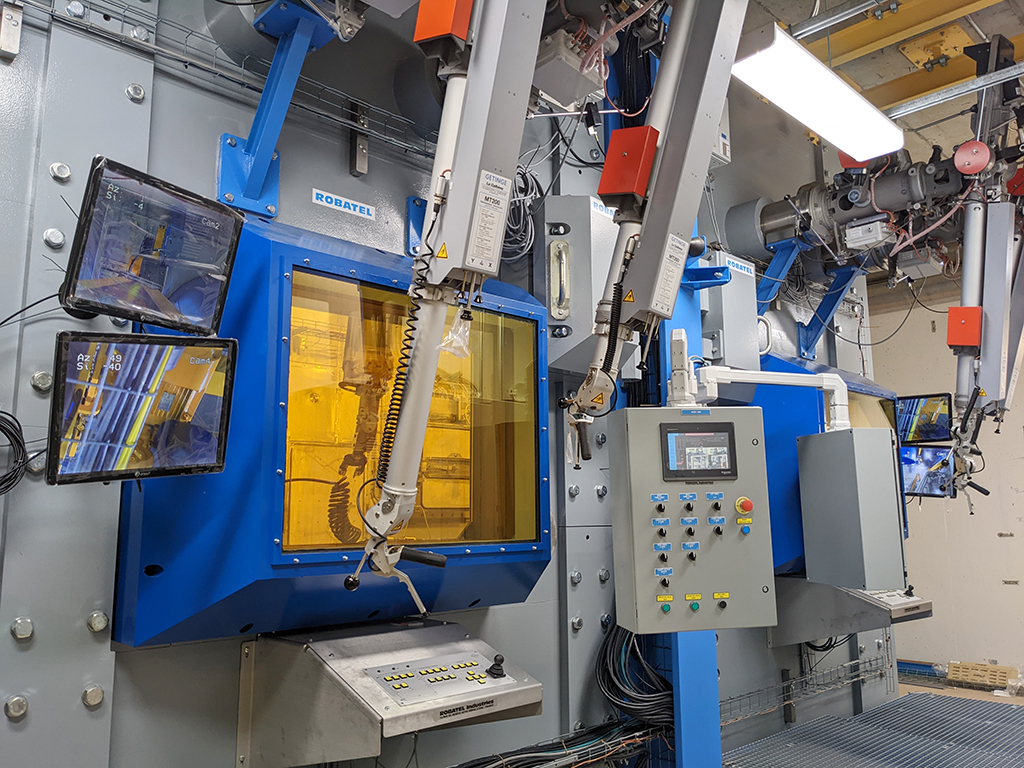
ARIEL Hot Cell, viewed from the front. Features lead-glass windows, two sets of telemanipulators, control consoles for equipment and camera operation.
Radiation protection at the core of ARIEL’s design
The ARIEL project will enable world-class research and shape the future of nuclear science and it would not be possible without careful attention to radiation safety. When ARIEL becomes operational, radiation fields in areas where regular operations and maintenance work will take place will be higher than what the TRIUMF remote handling group is accustomed to. However, ARIEL is designed to allow safe and efficient operations and maintenance work while minimizing radiation exposure to personnel.
Radiation protection and safety are at the core of ARIEL’s design, ensuring that isotope production and remote handling operations are conducted with minimal exposure to personnel. To achieve this, ARIEL incorporates a suite of advanced radiation protection and remote handling features that enable the safe and efficient exchange of isotope-producing targets and the maintenance of critical components. One such crucial piece of infrastructure is the ARIEL Hot Cell.
Targets and target vessels (hermetically sealed, multi-system containers that house the targets and enable the exchange of gases, cooling water, etc.) are critical pieces of the isotope separation online (ISOL) technique. To support the planned operational schedule, the targets must be modular, as they need to be replaced with fresh ones every few weeks.
In the summer of 2022, a critical piece of infrastructure at the heart of ARIEL was installed—the ARIEL Hot Cell. It is a lead-lined, room-sized containment chamber where technicians exchange isotope-producing targets and perform maintenance on the various modules used in ARIEL. The Hot Cell was a $10M international collaboration designed and assembled by ROBATEL Industries in France, then shipped to Canada and reassembled in ARIEL.
The Hot Cell will enable the exchange of two targets every three weeks, including packaging the radioactive waste of spent targets, as well as handling medical targets that are transferred to or from the cell via a pneumatic transfer line connected to the medical target module.
Some of the features that enable regular target exchange and maintenance work to be done include the following:
- Two sets of telemanipulators that allow operators to perform multiple complex tasks at the same time. The three-piece design of the telemanipulators allows for easy and remote removal for regular and incidental maintenance without having to enter the cell.
- Two large lead-glass windows designed to minimize optical distortions for operator viewing.
- Six high definition radiation-hard cameras with PTZF functionality. These cameras are expected to last the full lifetime of the system under fields at times up to 2 Sv/h.
- A lead and steel structure, including lead-clad entry ports and tool access ports. The 23 cm thick lead shielding was fabricated in multiple slabs that were shipped from France and assembled in-situ at TRIUMF.
- A target access hatch that can be used to insert or remove hermetic target vessels through the roof of the cell using a remotely controlled overhead crane.
- Two turntables that can support the weight of the 20 metric tonne modules, as well as rotate, raise, and lower.
- A 2000 kg lift table (a large platform) that can raise and lower to allow operators to work on heavy items.
- Two internal cranes—one single axis 60 kg hoist for handling target vessels and one two axis 1000 kg hoist for larger items.
- Inert gas services used for working with pyrophoric targets (specfically during waste packaging).
- A send and receive station that is connected to the medical module via a pneumatic transfer tube that will be used for extracting medical targets when they are ready for processing, isotope production, and installing new medical targets in preparation for beam delivery.
- A variety of custom remote handling jigs and tools to be used by the telemanipulators to perform maintenance and operations work.
- A nuclear ventilation system designed to prevent contamination outside of the cell that features remotely exchangeable filters.
- Making sensors, actuators, lighting, and other items that are expected to degrade or become damaged remotely exchangeable. This reduces the number of expected personnel entries into the cell for simple tasks.
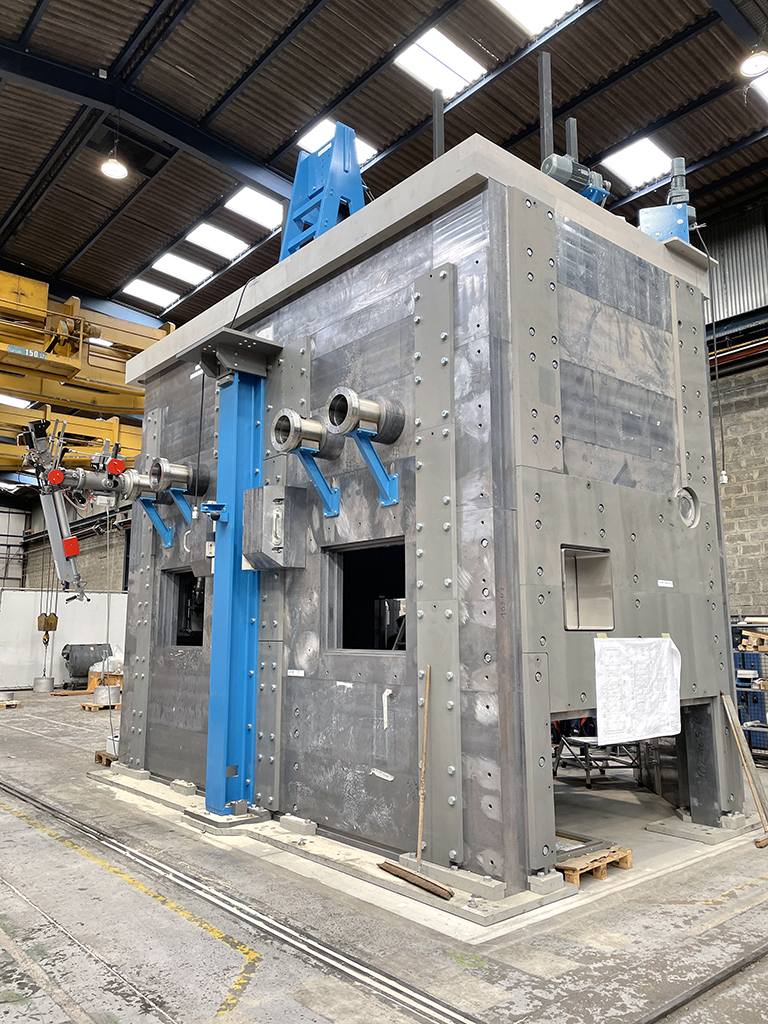
The ARIEL Hot Cell during construction – lead slabs shown. On the front are cutouts for the lead-glass windows, and four through-tubes for the telemanipulators.
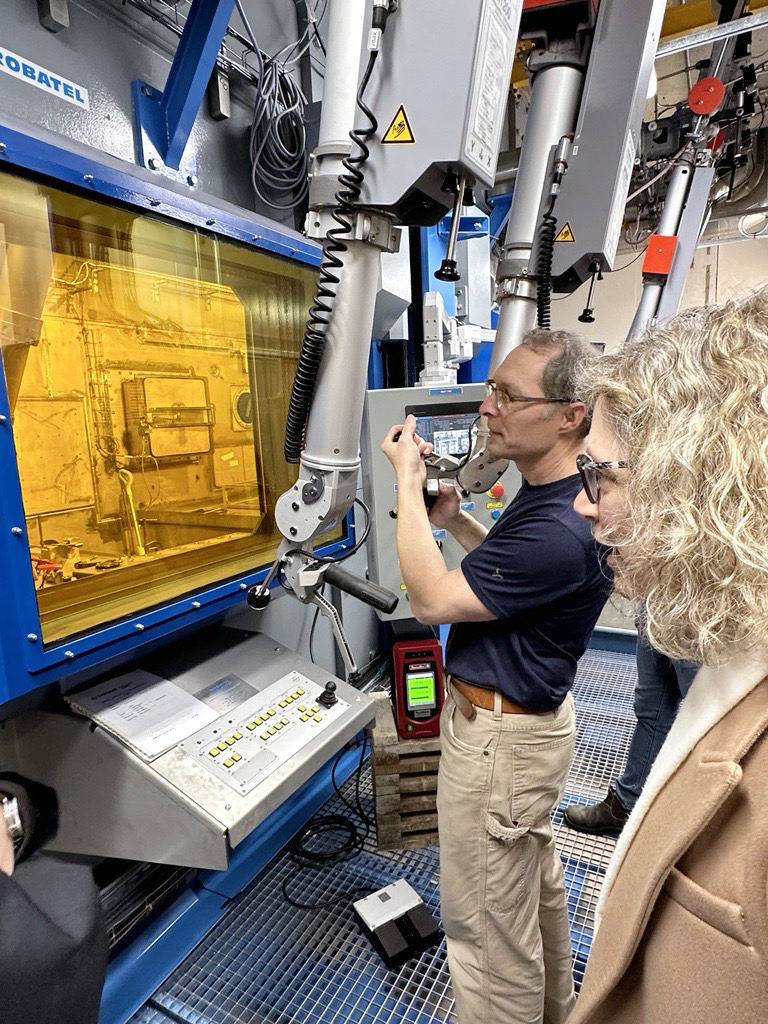
A Hot Cell operator stands in front of the controls during a tour.
Commissioning is expected to be complete in 2027
Preliminary commissioning tests for the ARIEL Hot Cell have already taken place successfully. Some modifications to the cell are required to prepare it for full ARIEL operations before commissioning will be considered complete (expected 2027). Currently, the Hot Cell is being used for operator training purposes as well as testing remote handling capabilities for maintenance of critical systems like the target module’s front end. The remote handling group at TRIUMF is developing custom tools and jigs in parallel with these tests.
In the coming years, ARIEL will become operational and the innovations from TRIUMFs scientists and engineers will come to life. ARIEL will enable world-class particle physics research, and produce medical isotopes for imaging and disease treatment. Among other radiation protection initiatives in the facility, the Hot Cell is a cornerstone piece of equipment which will support operations and maintenance efforts, while protecting personnel, for years to come.
You may also be interested in reading “A Legacy of Discovery TRIUMF’s Expanding Research Horizons” (May 30, 2025)
 Adam Newsome
 Adam Newsome
Adam, P. Eng., is a mechatronic systems engineer with a background in robotics integration and professional audio. He is presently the Remote Handling group leader at TRIUMF, where he leads a team of engineers, technologists, and tradespeople who specialize in remote-controlled systems aimed at reduction of radiological hazards.
Stuart Shepherd
 Stuart Shepherd
Stuart is TRIUMF’s deputy director of Communications and Engagement. He is an experienced and driven senior communication leader with a strong track record of developing and executing strategy, empowering teams, and driving impact in Canada’s research ecosystem. Stuart leads with empathy, curiosity, and a dedication to amplifying the impact of science.
Do you want to read more articles like this?
The Bulletin is published by the Canadian Radiation Protection Association (CRPA). It’s a must-read publication for radiation protection professionals in Canada. The editorial content delivers the insights, information, advice, and valuable solutions that radiation protection professionals need to stay at the forefront of their profession.
Sign up today and we’ll send you an email each time a new edition goes live. In between issues, check back often for updates and new articles.
Don’t miss an issue. Subscribe now!
Subscribe