
Collaborating to Promote the Accreditation of Radiation Safety Professionals in Canada
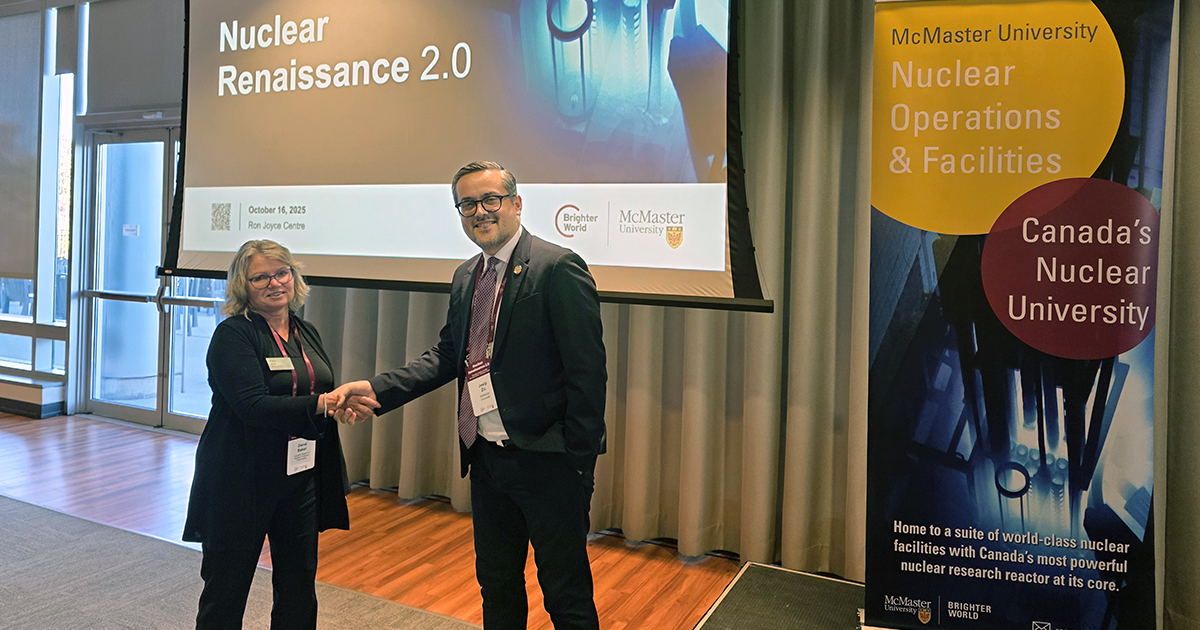
Diana Baker, NRRPT board member, and Josip Zic, CRPA president-elect, meet at the McMaster University Nuclear Renaissance 2.0 conference to sign the memorandum of understanding.
On October 16, 2025, the Canadian Radiation Protection Association (CRPA) and the National Registry of Radiation Protection Technologists (NRRPT) signed a memorandum of understanding (MoU) to collaborate on training, education, and accreditation of Radiation Protection Professionals in Canada, including Radiation Protection Technicians, Technologists, and Surveyors (RPTs).
CRPA administers the Registered Radiation Safety Professional (RRSP) designation, which is the highest level of radiation safety competency recognized by CRPA at the Canadian level. The purpose of the designation is to ensure that a regulator, employer, or member of the public can have confidence in the qualifications of a RRSP with the CRPA(R) credential. Individuals that meet the educational and experience requirements, demonstrate competence through the completion of a written examination that is administered by CRPA. Retaining the designation requires maintenance of CRPA membership, payment of a registration maintenance fee, and continuing education and professional development, which is monitored through the maintenance of registration program.
The CRPA designation ensures that a radiation safety professional has a strong and demonstrated knowledge of the Canadian Regulations and their implementation across various nuclear fields, ranging from nuclear medicine to nuclear power generation.
NRRPT was established in 1976 to meet the need for improved training programs and designation of RPTs. Initially, this designation was only focused on United States regulatory requirements, but it has since expanded to include Canadian regulatory requirements. This provides a pathway for Canadian RPTs to be designated and ensures RPTs have a basic understanding of the natural laws of ionizing radiation, the mechanism of radiation damage, methods of detection, and hazards assessment. The designation also ensures that RPTs remain active in the field of radiation protection and maintain technical competence through remaining acquainted with scientific, technical, and regulatory developments. Individuals that meet the educational and experience requirements may demonstrate competence through the completion of a written examination administered by the NRRPT.
The NRRPT designation ensures that a radiation safety professional has a fundamental knowledge of radiation protection concepts and experience putting them into practice, thus ensuring the safety of staff, the public, and the environment.
As the body representing Canada’s Radiation Safety Professionals, CRPA advances the development and communication of scientific knowledge and practical means for protecting people and their environment from the harmful effects of radiation consistent with the optimal use of radiation for the benefit of society. To meet this objective, CRPA promotes educational opportunities, the development of professional standards, and other national and international societies.
“With Canada being at the forefront of expanding nuclear technologies, the need for more qualified radiation safety professionals has never been greater,” says CRPA President Elect Josip Zic. Whether we are building Canada’s first small modular reactor (SMR), refurbishing nuclear power plants and planning new nuclear power plants, or leading the world in the research, development and production of radioisotopes, there is a shortage of qualified RPTs in Canada. For some projects, RPTs from outside Canada are still being imported to meet demand.
Under this MoU, our organizations will review how existing registrations align and meet with nuclear technology users to promote the designations and see how they can be best utilized to support the expanding use of nuclear technologies in Canada.
CRPA members interested in taking part in this initiative can reach out to the CRPA Secretariate for more information.
 Josip Zic
 Josip Zic
Josip has been the health physics director at McMaster University for more than eight years and is currently the interim chief nuclear officer for the organization. He is also the president of SHP Nuclear Services, where he provides consulting services regarding licensing, radiation safety program development, and the safe use of nuclear technology across the nuclear industry. Prior to joining McMaster, Josip worked as a health physicist, health physics section manager, and radiation protection manager at Ontario Power Generation for approximately 14 years. He is a registered radiation safety professional with the CRPA and a certified health physicist with the American Board of Health Physics. Josip is the president elect of CRPA, the co-chair of the World Nuclear Association Radiation Protection Working Group, and a member of various technical standards committees in Canada, including the Canadian Standards Association (CSA) Technical Committee for the management of radioactive waste.
Do you want to read more articles like this?
The Bulletin is published by the Canadian Radiation Protection Association (CRPA). It’s a must-read publication for radiation protection professionals in Canada. The editorial content delivers the insights, information, advice, and valuable solutions that radiation protection professionals need to stay at the forefront of their profession.
Sign up today and we’ll send you an email each time a new edition goes live. In between issues, check back often for updates and new articles.
Don’t miss an issue. Subscribe now!
Subscribe