

Optical Fibre Dosimetry for Proton Therapy: Research Highlight from TRIUMF
Patient dosimetry is a critical aspect of radioprotection during external beam radiotherapy, and it plays an even more critical role in proton therapy, where tissue dose rate changes rapidly along the beam travel direction.
TRIUMF, Canada’s national accelerator laboratory, is the only facility in Canada to have operated a clinical proton therapy centre. Between 1995 and 2019, more than 200 patients with ocular melanomas (a rare form of cancer) were treated with external proton beams at TRIUMF. While clinical operations have stopped, TRIUMF has transformed its beamline into the TRIUMF Proton Therapy Research Centre (PTRC) and is continuing its proton-therapy-related research program, with a focus on real-time dosimetry at both conventional and ultra-high dose rates.[1]
Proton therapy dosimetry is typically performed with ionization chambers and radiochromic films. However, both methods have some limitations. For example, ionization chambers have a limited resolution and radiochromic films cannot provide real-time information. Optical fibres have emerged as an attractive possibility for proton therapy dosimetry as they offer solutions to some of the limitations of dosimeters currently used in clinical practice. Additionally, they can operate in vacuum, as well as in vivo environments, at extreme temperatures, and in the presence of large electric and magnetic fields.[2]
In some fibre materials, exposure to radiation will induce the spontaneous emission of light in the visible spectrum, a phenomenon called radiation-induced luminescence (RIL). The material of the fibre core can be doped with certain elements, like cerium and nitrogen, to create more luminescent defect centres and increase the light yield under radiation.[3] The light created in the section of fibre under irradiation is transported along the rest of the optical fibre to a photon detector located outside of the radiation field, where the light intensity is measured and used to calculate the dose and dose rate in the radiation field. The main challenge of these RIL systems is that a very high dose rate on the fibre is required to create a measurable amount of light. A related dosimeter concept is to couple scintillating material to the optical fibre. The tip of the fibre can be hollowed out and filled with scintillating material, or a small piece of scintillating material of matching size can be attached to the fibre tip. The fibre then acts as a light transport system to the photon counter.
The ideal optical fibre system for proton therapy dosimetry should have a linear light yield response to dose over the whole clinically relevant range that is independent of dose rate and particle energy. The fibre material should be as near as possible to tissue-equivalent to reduce the need for corrections and calibrations. The fibres should also be as small as possible to maximise the spatial resolution.
Recent results from the PTRC demonstrate, for example, that a multi-fibre sensor system can provide, in real-time, beam profile information that is in agreement with radiochromic film measurements of the same beam,[4] as shown in Figure 1.
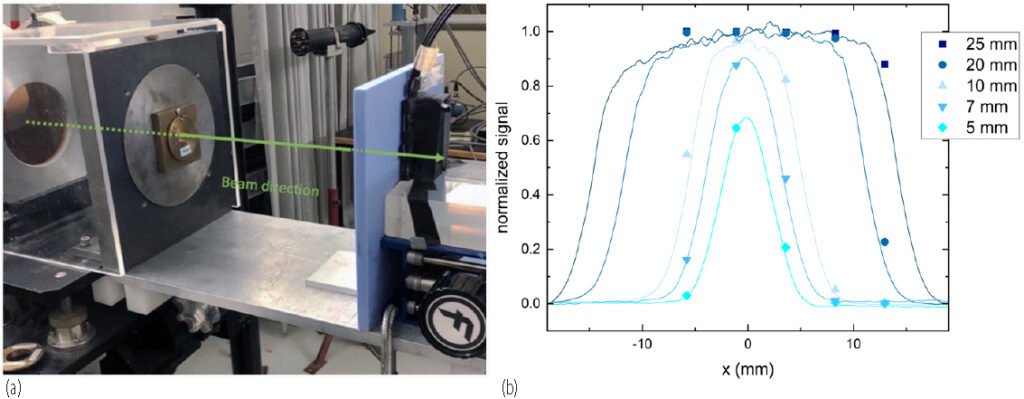
Figure 1: (a) Multi-fibre sensor prototype mounted on the 74 MeV beamline of the PTRC, (b) Beam profile for varying beam aperture size, measured with a multi-fibre array (points) and dosimetric film (lines). The intensity is normalized to 1 for both measurement methods at the highest measurement with the largest aperture.
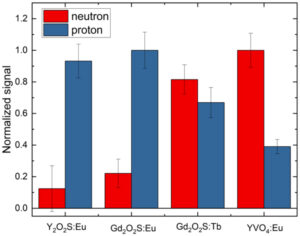
Figure 2: Comparison of the scintillating fibre sensor response to proton-induced dose and neutron-induced dose for four scintillating materials.
Optical fibres have also been exposed to the neutron beams available at TRIUMF. The difference in response of scintillating optical fibres to proton- and neutron-induced dose enables the design of a proton therapy patient dosimeter that can distinguish between the primary dose from the proton beam and the unavoidable but undesirable neutron dose to the patient that comes from the interaction of the proton beam with beamline elements and the patient’s own non-cancerous tissues.[5] The marked difference in response to proton- and neutron-induced dose between different scintillating materials studied at the PTRC is shown in Figure 2.
As a former proton therapy clinical facility, TRIUMF’s PTRC is an exceptional research asset for Canada, and the centre hosts both internal and external research teams interested in multiple topics related to proton therapy. The PTRC team is especially excited about the potential use of their research in improving patient safety during proton therapy treatments through high-precision real-time dosimetry.
References
[1] C. Bélanger-Champagne et al., “PIF & NIF: The Proton and Neutron Irradiation Facilities at TRIUMF.” Nuclear Physics News, vol. 34, no. 4 (2024): 25-30.
[2] S. O’Keeffe, “Optical Fibres for Radiation Dosimetry.” In: Matias, I., Ikezawa, S., Corres, J. (eds) Fiber Optic Sensors. Smart Sensors, Measurement and Instrumentation, vol 21. Springer (2017): 149-165.
[3] F. Fricano et al., “Very High Dose Rate Proton Dosimetry with Radioluminescent Silica-Based Optical Fibers,” IEEE Transactions on Nuclear Science, vol. 71, no. 8 (2024): 1829-1836.
[4] C. Penner et al., “A Multi-Point Optical Fibre Sensor for Proton Therapy.” Electronics, vol. 13, no. 6 (2024): 1118.
[5] J. Niedermeier et al.,“Optical fibers as dosimeter detectors for mixed proton/neutron fields—A biological dosimeter.”Electronics vol. 12, no. 2 (2023): 324.
 Camille Bélanger-Champagne
 Camille Bélanger-Champagne
Camille is an experimental physicist at TRIUMF. She coordinates the activities of the proton and neutron irradiation facilities, where electronic components and systems, sensors, and other materials undergo radiation testing.
Cornelia Hoehr
 Cornelia Hoehr
Cornelia is the director for the Life Sciences Division at TRIUMF, senior research scientist at TRIUMF, and an adjunct professor at the University of Victoria and the University of British Columbia, Okanagan. Her research focuses on the targets for the production of novel medical isotopes and novel modalities for cancer therapy.
Do you want to read more articles like this?
The Bulletin is published by the Canadian Radiation Protection Association (CRPA). It’s a must-read publication for radiation protection professionals in Canada. The editorial content delivers the insights, information, advice, and valuable solutions that radiation protection professionals need to stay at the forefront of their profession.
Sign up today and we’ll send you an email each time a new edition goes live. In between issues, check back often for updates and new articles.
Don’t miss an issue. Subscribe now!
Subscribe