

Sharing Lessons, Shaping Safety: A Report from the 2025 International Technical Safety Forum
I recently had the opportunity to attend a conference called the International Technical Safety Forum (ITSF). The conference was hosted at the Rutherford-Appleton Laboratories (RAL) located just outside of Oxford, England, and brought together a variety of safety specialists from large science projects around the world.
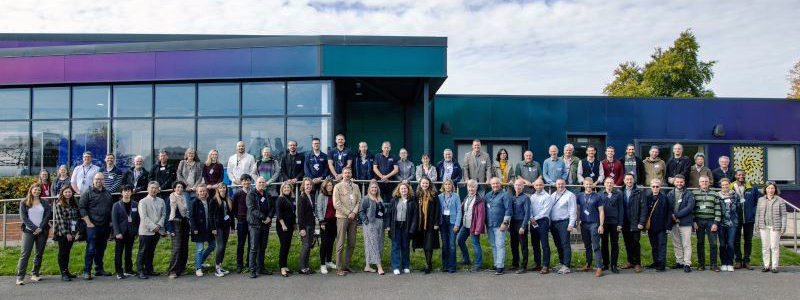
2025 International Technical Safety Forum (ITSF) attendees in front of the Rutherford-Appleton Laboratory
In the words of the conference organizers:
The International Technical Safety Forum (ITSF) is an informal practitioner led forum to exchange lessons learned and state-of-the-art ideas, processes, procedures, and technologies in personnel, environmental, and equipment safety. The ITSF community ranges from large-scale high-energy physics facilities through to spallation neutron sources, synchrotron radiation and cyclotron laboratories from across the world.[1]
The representation at the conference included staff from
- European Organization for Nuclear Research (better known as CERN),
- Diamond Light Source in Oxford, England,
- DESY (Deutsches Elektronen-Synchrotron) Research Center in Hamburg, Germany,
- ESS (European Spallation Source) in Lund, Sweden,
- ELI (Extreme Light Infrastructure) near Prague, Czechia,
- JPARC (Japan Proton Accelerator Research Complex) in Japan,
- Vera C. Rubin Observatory in Chile, and
- many other leading research centres and large-scale science facilities from around the world.
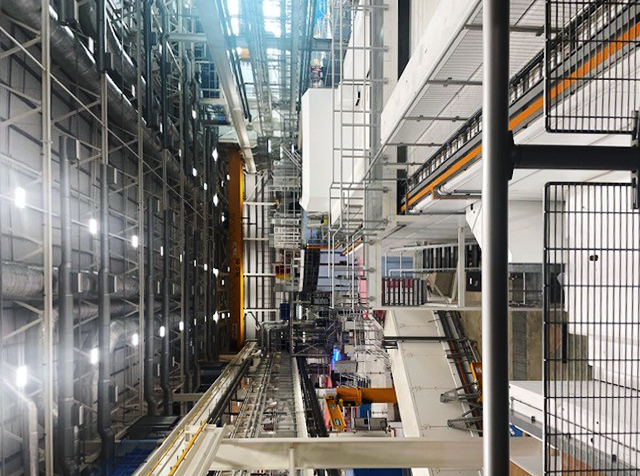
ITSF 2025 ISIS Neutron and Muon Facility
The conference is typically held every two to three years, at a different geographic location each time—Europe, Asia, and North America have all taken turns as hosts. Included in the conference are a number of tours of the host’s science facilities, as well as ample opportunities for networking with conference attendees. The United States, through the Department of Energy staff, played a major role in getting the conference started, and has been an important contributor in years past. Unfortunately, no U.S. participants were able to attend this year.
The ITSF includes staff from many facilities where radiation protection is a key component of the safety program. Yet, the presentations at the conference go beyond radiation protection by including specialists in biosafety, fire protection, emergency response, lasers, and many other areas related to, but sometimes considered outside of, traditional radiation protection programs. A concerted effort is made to discuss the variety of safety programs at the facilities represented. The talks this year ranged from new facility commissioning, decommissioning older facilities, safety culture assessment and monitoring, work management concerns, and recent events at the facility where an incident resulted in injury, potential injury, or serious consequences to the safety operation of the facility.
It is the last topic that really draws me to this conference. This is the second time I have attended the conference, and both times I have been impressed by the candour of the speakers, the events, and the issues they cover. The presenters speak openly and in considerable detail about the incident, the results of any investigations, and the corrective actions either implemented or planned. Even though it is sometimes uncomfortable, the participants understand the value of sharing the information. The incident is viewed as a learning experience, and in keeping with the purpose of the conference, the experience is shared with other safety practitioners to help improve programs at all facilities.
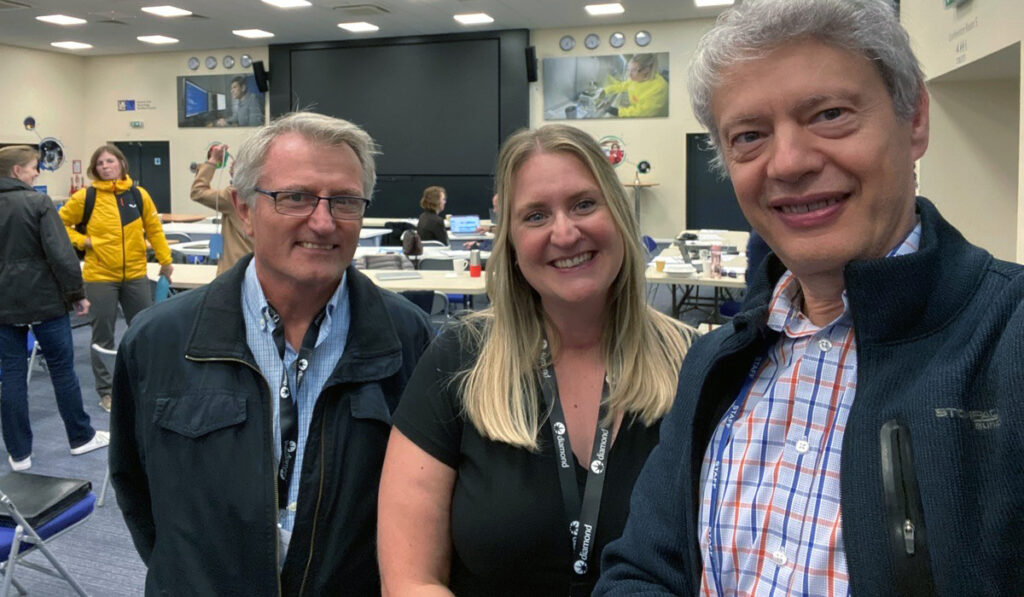
From left to right: Grant Cubbon, Canadian Light Source (CLS) Health, Safety, and Environmental Department manager; Meghan Allen, CLS Biological, Chemical, and Occupational Health and Safety lead and president of the Canadian Association of BioSafety; and Gianluigi Botton, CEO Diamond Lightsource.
Canada was represented at the conference by three staff members from the Canadian Light Source. Two presentations were provided as our contribution to the discussion topics. In addition, the Canadian Light Source has been named as the host for ITSF 2027. Planning is underway, and the conference will likely take place sometime in May or June in beautiful Saskatoon.
You can find more information regarding this year’s conference at International Technical Safety Forum ITSF 2025. If you are interested in learning more about ITSF 2027, please feel free to contact me anytime. Hopefully, you will consider attending in 2027!
_____________
[1] From the Second Announcement of ITSF 2024: Call for Abstract Submission and Travelling Information.
 Grant Cubbon
 Grant Cubbon
Grant has worked in radiation protection at the Canadian Light Source (CLS) since 2003. He has been the Health, Safety, and Environmental Department manager since 2013, and served as the radiation protection and control coordinator before that. From 1989 to 2002, he was a laboratory technician and supervisor at the Radiation Safety Institute of Canada’s National Laboratory.
Grant was a director on the Canadian Radiation Protection Association (CRPA) board from 2016 to 2022 and has served as deputy editor of the CRPA Bulletin since 2018.
Do you want to read more articles like this?
The Bulletin is published by the Canadian Radiation Protection Association (CRPA). It’s a must-read publication for radiation protection professionals in Canada. The editorial content delivers the insights, information, advice, and valuable solutions that radiation protection professionals need to stay at the forefront of their profession.
Sign up today and we’ll send you an email each time a new edition goes live. In between issues, check back often for updates and new articles.
Don’t miss an issue. Subscribe now!
Subscribe