
We Are Family
60 Years of the Société Française de Radioprotection and a Shared Heritage in Radiation Protection
A shared heritage in radiation protection
My title, “We Are Family,” is a reference to the musical hit from the 1980s by Sister Sledge. That I have referenced this song title might be a reflection of me being old enough to have had a 33-year career in applied health physics, but it’s also an appropriate reference for the ties between the Société Française de Radioprotection (SFRP) from France, the Canadian Radiation Protection Association (CRPA), which I represent here, and our common parent organization, the International Radiation Protection Association (IRPA).
Celebrating 60 years of SFRP
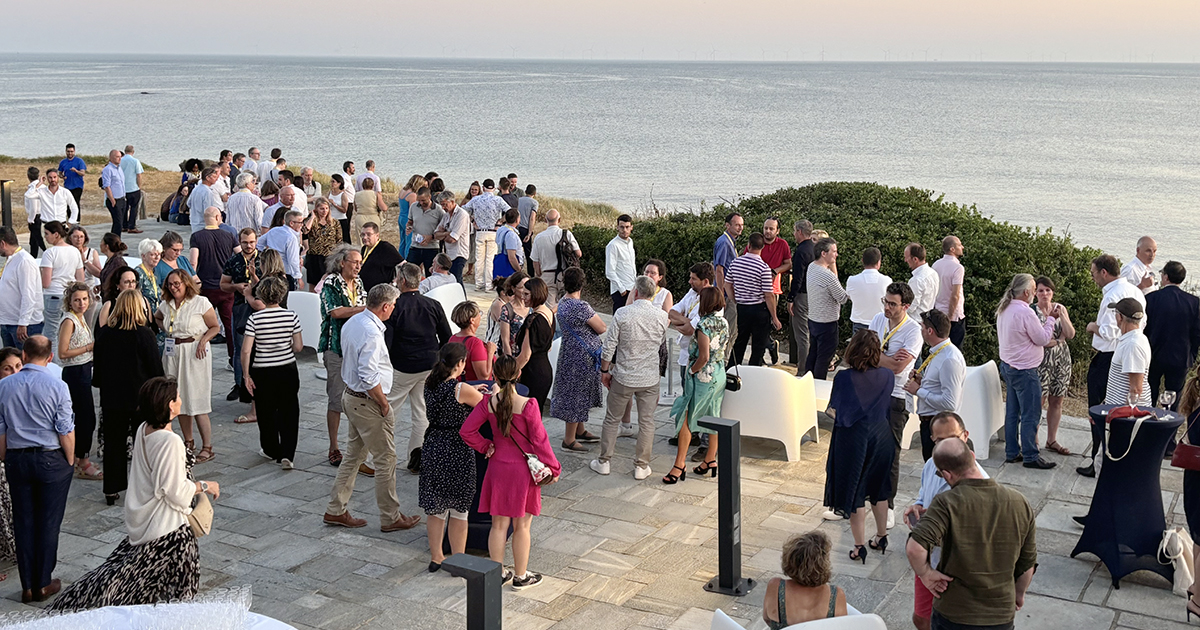
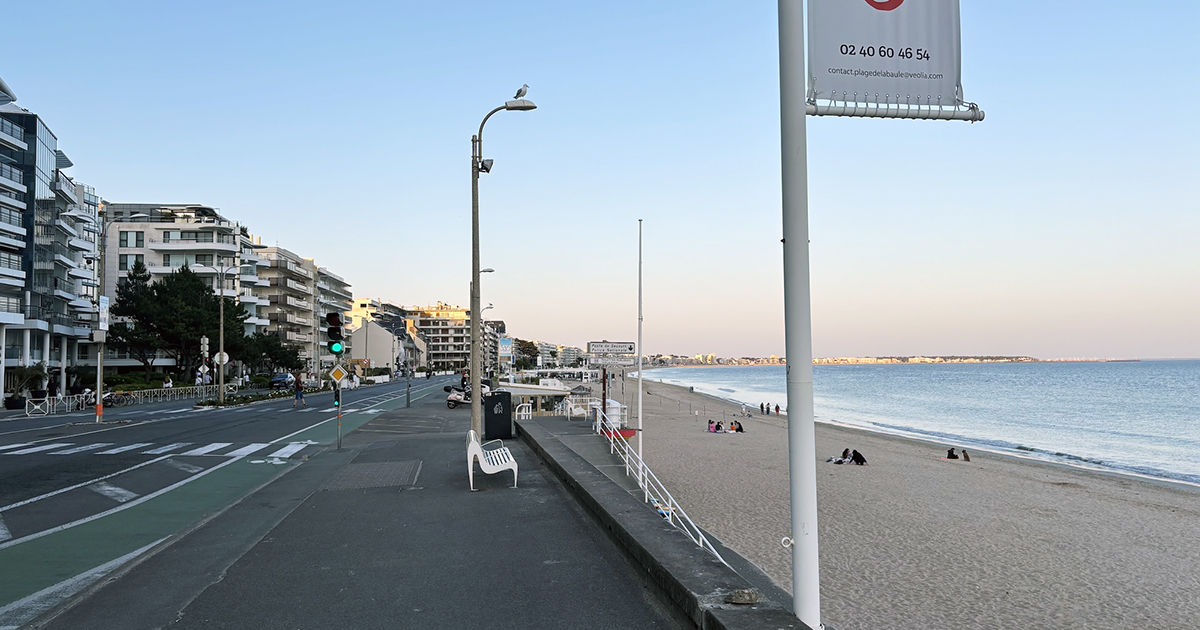
In 2025, SFRP, which has around 1,500 members, celebrated its 60th anniversary. For this milestone, the society invited its extended radiation protection family to La Baule, France, a charming seaside destination, from June 17 to 19. The town was quiet, still waiting for the tourists who would soon arrive to appreciate its generous coastline.
There was no need for sunscreen, as UV rays could not penetrate the conference venue. The family guests honoured the invitation to celebrate science, and around 360 participants and 24 technical exhibitors devoured the 50 or so lectures and 40 scientific posters covering various topics. From the opening remarks by SFRP President Patrick Devin, the atmosphere was professional, solemn, but also friendly. It quickly became clear that, regardless of the country, radiation protection presents its own set of challenges because it touches something that is quite universal, and not always rational—human beings.
It was from this perspective that I approached the conference. I was seeking to improve the operability of the radiation protection concepts that I have to convey, because radiation protection is not a closed system. As radiation protection professionals, we talk to people—we call them patients or workers; we group them into cohorts or populations; but if we want to apply the concepts, we have to know, a priori,[1] how to reach people with science. A recent pandemic demonstrated how challenging this can be.
Outgoing President Devin, current SFRP President Pierre-Yves Hémidy, and several members of the SFRP executive committee are skilled in human factors[2] and applied science, as would be evident in the presentations and friendly gatherings over the following days.
Merging institutions and emerging challenges
Within families, some marriages are celebrated, while others are disapproved of. Mr. Pierre-Marie Abadie, president of the Agence de Sûreté Nucléaire et de Radioprotection (ASNR), opened the conference with a speech to mark the first year of a union between the former regulatory body, the Agence de Sûreté Nucléaire (ASN), and former public research entity, the Institut de Radioprotection et de Sûreté Nucléaire (IRSN). According to the boss of the new entity, it must find a foothold in research with strategic and operational coherence to navigate challenges such as AI, natural exposure, and radiation protection culture. I could have sworn I also heard representatives of the Canadian Nuclear Safety Commission (CNSC) express themselves in this way during the CRPA professional conference last May!
One room, many voices
At the SFRP conference, there was no need for the gift of ubiquity, as there were no concurrent sessions that required you to shuffle between rooms, depending on your interests. The plenary was held in a colourful and modern space where we sat as if in a comfortable living room. The presentations in that room reminded us that we live in a world that increasingly doubts science and uses virtual spaces that feed on emotional communication, largely from social media. J.L. Lachaume, representative of Heads of the European Radiological Protection Competent Authorities (HERCA), announced the recent publication of a position statement on the importance of maintaining confidence in science, which is indirectly intended as a response to the U.S. executive order from May 2025 that directly attacks the scientific validity of the linear no-threshold (LNT) theory.
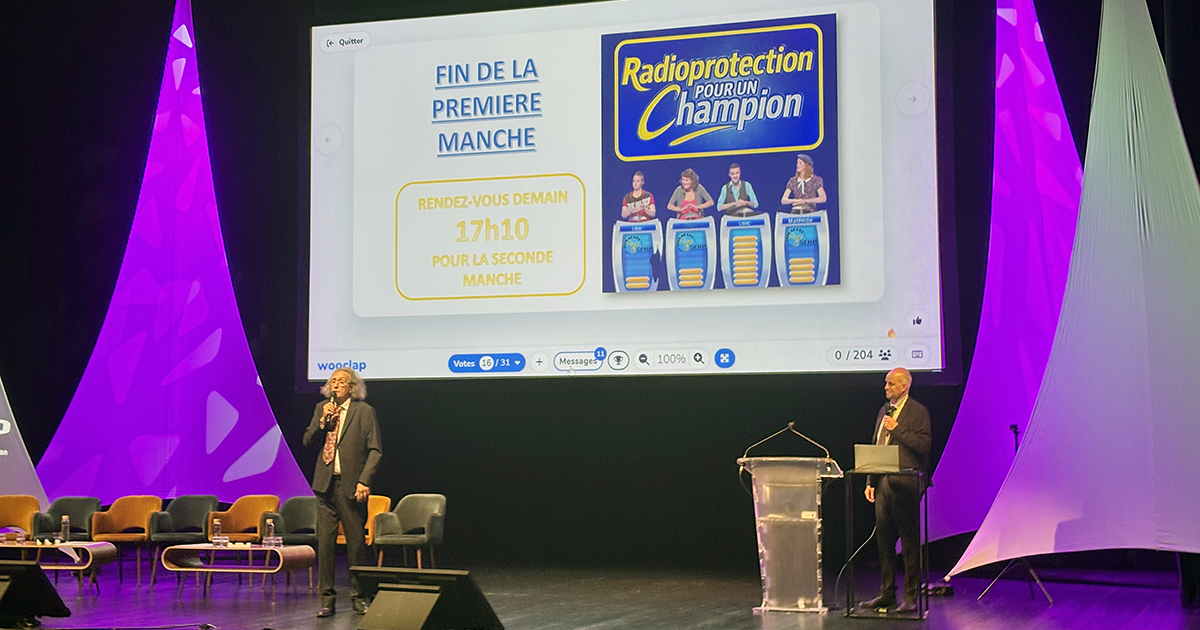
Marc Ammerich hosting the “Radiation Protection for a Champion” event.
A family is also a mix of generations that challenge or reinforce each other’s positions. The new generation that is spreading its wings with confidence, boldness, or even certainty, and the “experienced” generation that is holding steady or hovering along the famous Dunning-Kruger curve.[3] Young SFRP members are given a well-deserved place at SFRP conferences, bringing great hope for the future of the discipline through their practical and essential involvement in the smooth running of each event and through their science communication, some of them competing for the Henri Jammet[4] Award, which rewards a young member for outstanding research presented at the conference. Congratulations to all of this year’s participants, especially the winner, Charles-Philippe Mano from Commissariat à l’Énergie Atomique et aux Énergies Alternatives (CEA). He presented a new method of global spectrum analysis for real-time airborne measurement.
Conference participants could vote for the best posters, and these three received the most votes:
- Optimization of a Passive Trapping system and Process to Determine C-14 in the Atmosphere by Liquid Scintillation (Hugo Jaegler, Michaël Petitfrere, Roselyne Beurel, Danièle Dias Varela, Kevin Galliez, Cyril Pineau, Rawiya Arioua, Vanessa Durand, Azza Habibi [ASNR])
- Scientific Heritage and Radiological Risk: Management and Conservation of the Muséum National d’Histoire Naturelle’’s Collection of Radioactive Minerals (Caroline Noyes, Cristiano Ferraris [MNHN])
- A Serious Game to Raise Awareness about Environmental Radiation Protection (Catherine Mercat, Frédéric Brun, Nadège Gimenez, Géraldine Boivin-Delpieu, Patrick Devin [Orano])
Talks that shaped the conversation
For its 2025 birthday, the SFRP conference featured a series of talks:
- The International Commission on Radiological Protection (ICRP) talked about moving toward a sustainable environment with the revision of its system, which could incorporate 14 of the 17 recognized parameters of sustainable development.
- The French Authority for Nuclear Safety and Radiation Protection (ASNR) talked about its participation in the Fukushima contaminated water analysis intercomparison program—which, at the start of the program, received a shipment of flamenco dresses instead of the expected samples . . . One can imagine the dancers’ reactions upon receiving bottles of water!
- The Agence Nationale pour la Gestion des Déchets Radioactifs (ANDRA) talked about their assessments of the harmfulness of nuclear waste, working groups, and inclusion of influencers.
- CRPA talked about a first-of-its-kind international symposium on patient radiation protection held in Canada in September 2024.
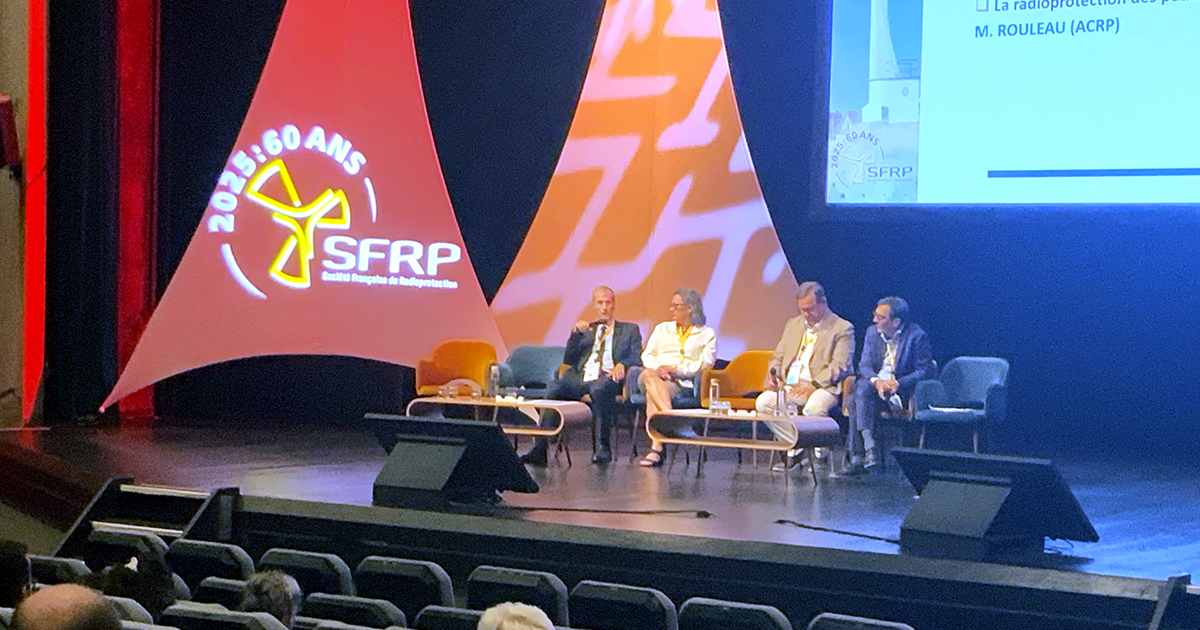
Participants also heard from many of the other usual suspects in radiation protection who talked about a wide range of topics—the nuclear industry and sustainable management in radiation protection, the ecotoxicity of ionizing radiation, AI in radiation protection, regulation, dosimetry challenges, radon, and non-ionizing radiation (from the retina affected by LED matrices, to studies of the behaviour of insulin pumps under low-frequency fields, to the risks for pregnant patients undergoing MRI).
Wisdom from the “family elders”
At many family gatherings, a popular uncle, aunt, brother, or sister will often demonstrate their great wisdom, thereby providing necessary food for thought. There were several such moments of quality at the SFRP conference, all identified as “guest lectures.”
Maxence Cordiez, energy engineer, researcher, and science communicator, is concerned with today’s challenges for tomorrow’s world with regard to the links between climate and energy. His presentation was a solid but traditional reminder of the issues. Our energy production heavily relies on burning fossil fuels, which are more accessible than alternatives and allow for increased production. However, it releases greenhouse gas (GHG) emissions (including carbon dioxide) and is responsible for climate change. We must decarbonize, electrify, and reduce energy consumption. Carbon neutrality is as much a challenge for society as it is for the energy sector.
Étienne Klein, physicist and philosopher of science, spiced things up with a long and fascinating discussion on a fairly well-known concept in radiation protection: risk. Science provides objective knowledge, but also certain uncertainties that are exacerbated by new technologies. Klein quoted Paul Valéry, and this quote could very well have served as a common link between many of the other guest speakers: “L’homme sait assez souvent ce qu’il fait, il ne sait jamais ce que fait ce qu’il fait.”[5]
Klein presented on progress and innovation. Klein said, “Believing in progress means accepting to sacrifice one’s personal present for the sake of a collective future . . .” Sensitivity to risk is “. . . exaggerated by the fact that we have lost sight of the meaning of history.” Innovation, at its inception, is associated with a principle of conservation: “Innovation is what must be done so that nothing changes, or it is what must be changed so that nothing changes.” Klein pointed out that innovation is currently being used in the same way as it was at its inception—to repair what has been damaged by the wear and tear of time, rather than as a solution that leads to a collective vision for the future in the same way as the “year 2000” was for an entire generation.
Géraldine Pina of ASNR is an engineer and physician. She has been touted as a future recipient of the French Legion of Honour and stands out for her involvement in the United Nations Scientific Committee on the Effect of Atomic Radiation (UNSCEAR) and ICRP. She presented on radiation protection issues in the medical field. The U.S. executive order was once again the preamble to her discussion. The United States Nuclear Regulatory Commission must base its decisions “on science” and is asking for the LNT model to be reconsidered, as it is seen as an obstacle to development. And, between the lines, Pina raised the issues of economic competitiveness of new nuclear technologies and the adaptability of regulators. Is it an obstacle to doing business? There are calls for a more flexible and adapted regulatory framework everywhere, including Canada. But what does that mean? The culture of radiation protection must stay strong and must always be able to measure certain indicators.
Bernard Le Guen, International Radiation Protection Association (IRPA) executive secretary and former president, as well as an SFRP past president, sent a video message wishing SFRP a happy anniversary. He was surrounded by several representatives from 20 African countries who were gathered in Brazzaville, Republic of the Congo, to work on the same topic he would later be presenting to SFRP: radiation safety culture in the medical field. This topic echoes the recent scientific contribution[6] to this subject by the World Health Organization (WHO), together with IRPA, the International Organization for Medical Physics (IOMP), and the International Atomic Energy Agency (IAEA). Le Guen emphasized the role of IRPA in passing on the culture of radiation protection from one generation to the next, and in showing how to take the right actions. The IRPA family has a rich and extensive genealogy, with 19,000 members and branches spanning every continent.
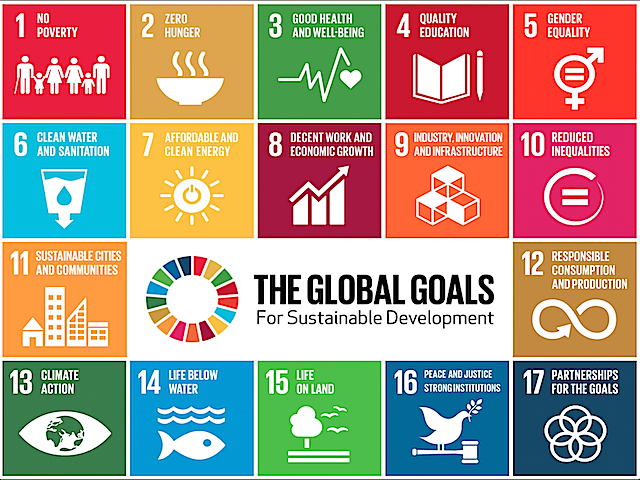 Hildegarde Vandenhove, IAEA director, engineer, and expert researcher in radioecology, confronted us with the optimization of radiation protection in radioactive waste management. The IAEA supports the United Nations’ 2030 Agenda centred on the use of the 17 Sustainable Development Goals,[7] as previously discussed at this conference by ICRP Task group chair Thierry Schneider. The sustainable use of nuclear energy covers at least nine goals. We are talking about safety and sustainability, which are intrinsic: the key to sustainability is safety, and sustainability informs safety. “Safety is not an end in itself, but a prerequisite for the protection of people,” Vandenhove said.
SFRP sharing knowledge
As stated on its website, the SFRP wishes to “share its experience.” It walked the talk by publishing, in the public domain, an impressive number of videos of keynote addresses and various presentations. Recordings from SFRP’s 2025 Congrès national de Radioprotection, including several of the presentations I have described above, can be found on the SFRP website.
In addition, the SFRP has a scientific communication organ, Radioprotection Journal, whose articles are reviewed by a sharp editorial team led by Mr. Berthot and Mr. Bourguignon.
To grow its membership and expand its family, SFRP has released a series of short videos aimed at people in the field of radiation protection education that highlight certain professions and training programs for tomorrow’s employees, as well as the internships required to access them. SFRP is casting a wide net, and that’s a good thing—skilled labour is a universal challenge. All professional associations should take note of this very good idea.
Celebrating in style
The SFRP conference is serious business, but SFRP knows how to have fun too. The 60th anniversary celebration in the well-named Batz-les-Mers combined summer warmth with a family atmosphere. The “Radiation Protection for a Champion” contest allowed participants to test their knowledge of radiation protection in a playful way.
Latin characteristics are also very much in evidence at SFRP—good cuisine, good wine, warmth of the exchange and, on some occasions, approximative punctuality. We knew when the presentations started, but we sometimes ended up running late due to the audience’s passionate exchanges with the speakers or very long questions for the experts (by other experts). This was different from the ICRP Symposium in Tokyo in 2023, where even social events were stopped sharply on time, with the efficiency of a Shinkansen schedule.[8] But time is relative, you might say, and you would absolutely be quite right!
Radiation protection professionals from around the world appreciate this high-level scientific gathering, which takes place every two years, alternating with another applied radiation protection event. I can testify that this conference has consistently been well organized over the years, thanks to the conductor and her first violinist. Greetings and thanks go to Valérie Chambrette and Christine Guerreiro, who always give you a warm welcome, and to Fabrice LePrieur, chair of the scientific and organizing committee for the 2025 conference.
Of course, you have to be able to understand Molière, or a French menu, at least, to grasp the speakers’ presentations. And that is precisely why the North American from Quebec who is writing this article, a member of CRPA, the Health Physics Society, and of SFRP, feels at home among his cousins who are so talented in radiation protection.
Merci et à bientôt
By the way, in 2027, Troyes (Champagne region) will host a new radiation protection family party, with bubbles I would presume . . . Cheers and long life to SFRP. I’m looking forward to seeing you in Troyes.
Notes
[1] A priori is a Latin phrase used to describe a type of knowledge that comes from theory rather than observation or experience.
[2] Human factors is a multidisciplinary field that attempts to understand and improve the interaction between humans and the systems they use. (“Human Factors of Radiation Protection” by Yasamin Dadashi, Candesco, CRPA Bulletin, Vol 33, No 1)
[3] The Dunning-Kruger curve illustrates the cognitive bias where people with low ability in a topic overestimate their knowledge.
[4] Dr. Henri Jammet is one of the two “fathers” of the SFRP, which was formed by the merger of the Société de radioprotection de Jammet (Jammet Radiation Protection Society) and the French section of the Health Physics Society, established by Mr. Francis Duhamel.
[5] “Man often knows what he is doing; he never knows what his actions will achieve.” This quote is believed to have originated from Paul Valéry’s book Variety, first edition, (Paris: Gallimard).
[6] Enhancing Radiation Protection Safety Culture in Health Care: Guidance for Health Care Providers.https://www.who.int/publications/i/item/9789240091115
[7] The United Nations’ 2030 Agenda for Sustainable Development is a global action plan adopted by all UN Member States in September 2015 to guide efforts to end poverty, protect the planet, and ensure prosperity and peace for all by 2030. The centerpiece of the 2030 Agenda is a set of 17 Sustainable Development Goals (SDGs).
[8] The Shinkansen, also known as the “bullet train” in English, is a network of high-speed railway lines in Japan.
 Stéphane Jean-François
 Stéphane Jean-François
Protecting the wide diversity of people who use ionizing radiation since 1992—that sums up the career of Stéphane Jean-François, physics engineer. Within CRPA, he found experts, allies, and friends who encouraged him to excel. He served as a director, and later president of the board, was the editor-in-chief of this Bulletin and was recognized for his contributions with the CRPA Founder’s Award and Meritorious Service Award.
Stéphane has stepped out of his comfort zone on several occasions, in process safety, environmental management, emergency response, and communication (a field he is particularly fond of). Stéphane works as a certified health physicist for Radioprotection Inc., a company that allows him to put on a lab coat in the morning at a hospital and a fire-retardant suit in the afternoon at a refinery, all to improve radiation protection and pass it on to the next generation of professionals. He spends his vacations attending radiation protection conferences and training courses around the world.
Do you want to read more articles like this?
The Bulletin is published by the Canadian Radiation Protection Association (CRPA). It’s a must-read publication for radiation protection professionals in Canada. The editorial content delivers the insights, information, advice, and valuable solutions that radiation protection professionals need to stay at the forefront of their profession.
Sign up today and we’ll send you an email each time a new edition goes live. In between issues, check back often for updates and new articles.
Don’t miss an issue. Subscribe now!
Subscribe