

2026 Anthony J. MacKay Student Paper Contest: Meet This Year’s Finalists

Each year, the Student and Young Professionals Committee organizes the Anthony J. MacKay Student Paper Contest in conjunction with the CRPA annual conference. The contest is open to all students enrolled full-time in a Canadian college or university program related to the radiation sciences.
Entrants must submit an abstract of no more than 750 words on a topic that is related to some aspect of radiation; the topic is intentionally kept broad to encourage participation from a wide range of students.
Three finalists are selected to present their work at the conference in a plenary session. Conference registration (including the banquet) and three nights hotel accommodation are provided for all three finalists.
The presentations are judged at the end of the session, and the winner is announced during the awards banquet. The winner is presented with the Anthony J. MacKay trophy and receives a $250 cash prize.
All students who enter the contest are given a free one-year membership to the CRPA.
Meet this year’s finalists!

Ann Drakes
Master’s in nuclear engineering (first year)
Ontario Tech University
Biography:
I am currently pursuing a master’s degree in nuclear engineering, with research experience in neutron detector development, radiation measurement, and reactor physics applications. My work integrates experimental detector design and testing with high-fidelity computational modelling, using tools such as MCNP and Geant4 to simulate particle interactions and complex radiation environments.
I have contributed to a peer-reviewed publication on nuclear science and engineering, with earlier research supported by the Natural Sciences and Engineering Research Council of Canada (NSERC) Undergraduate Student Research Award. With a background in astrophysics and a passion for particle physics, I bring a versatile skill set in experimental methods, simulation, and data analysis to the study of subatomic processes and radiation detection.
Outside of research, I am a wife and mother of three. I enjoy snowboarding, swimming, and crafting.
Synopsis of Paper:
Feasibility Assessment of 3D Neutron Flux Reconstruction for Reactor Physics and Radiation Protection in a Graphite-Moderated Subcritical Assembly Core Using Multi-Material Scintillator Arrays and GEANT4
Co-author: Kirk D. Atkinson, Ontario Tech University
Accurate reconstruction of spatial neutron flux distributions in subcritical reactor assemblies is essential, not only for validating neutronics models and characterizing neutron multiplication behaviour, but also for supporting radiation protection, shielding assessment, and ensuring safe operation in university-level reactor research environments. This work investigates the feasibility of three-dimensional (3D) neutron flux mapping within a graphite-moderated subcritical assembly through the development and simulation of a compact multi-detector system capable of simultaneously measuring thermal and fast neutron fields. An array of miniature scintillator detectors, including 6LiF:ZnS(Ag), HDPE+6LiF:ZnS(Ag), EJ-276, and CLYC, were integrated with silicon photomultipliers to enable localized neutron monitoring within the tight spatial constraints of the graphite lattice.
A Geant4 Monte Carlo model was developed to evaluate detector response, optimize placement for representative flux and dose conditions, and assess measurement accuracy under realistic neutron fields. The model incorporates neutron capture, scattering, scintillation light production, and photon transport, thus enabling comparison of energy-dependent neutron sensitivity across detector materials. Preliminary results demonstrate that embedded detector arrays can accurately reproduce axial and radial flux distributions, supporting both reactor physics studies and improved neutron field characterization for radiation protection applications.
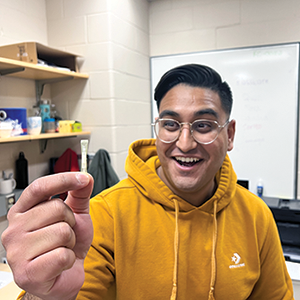
Amitoj (Joe) Singh
Master’s of science in biomedical engineering (first year)
University of Saskatchewan
Biography:
I have an academic background in chemical engineering and biology, and I hold a fifth-class power engineering certification. I am currently completing a Master of Science degree in biomedical engineering at the University of Saskatchewan, with an academic focus on cyclotron targetry and automated radiochemistry and peptide synthesis systems.
I work as an operations technologist at the Fedoruk Centre, where I operate the cyclotron, lead target and target station manufacturing for radioisotope production, and support radiolabelling and imaging research infrastructure development. I am also a co-founder and director of General Science Inventions Inc., a Saskatoon-based company that designs and manufactures equipment for radioisotope production, synthesis, purification, radiation shielding, and decontamination.
Synopsis of Paper:
Enhancing Radiation Protection in Radioisotope Shipping Through Nested Shielding Inserts
Co-author: Matt Hutcheson, CRPA(R) Radiation Safety Officer, University of Saskatchewan
Zirconium-89 (⁸⁹Zr) produced at the Fedoruk Centre in Saskatoon is shipped in 2 mL vials. However, commercial tungsten or lead transport containers (“pigs”) are designed for 30 mL vials. Due to this mismatch, substantial dead volume exists that contributes to elevated external dose rates and challenges compliant with transport of dangerous goods (TDG) limits and as low as reasonably achievable (ALARA) principles.
To address this problem, this research presents the design, fabrication, and testing of an inner shielding insert (“piglet”) that concentrically nests inside an existing pig, both securing the smaller vial and converting dead volume into effective shielding. Piglets were fabricated by casting and machining lead and, subsequently, bismuth to mitigate concerns about lead contamination while preserving shielding performance.
Dose rate measurements around the pig were collected with and without piglets using ⁸⁹Zr sources. Results showed substantial dose reductions with both materials, particularly along the axial direction of the vial, where shielding was previously weakest; for example, top and diagonal dose rates were reduced by several folds in both lead and bismuth tests. While absolute dose rates differed due to different source activities, consistent attenuation improvements were observed across all measurement locations.
Overall, the piglet design effectively enhances radiation shielding without modifying existing transport containers, enabling up to a ~90% increase in shippable ⁸⁹Zr activity at the same transport index. The bismuth version offers comparable performance with reduced toxicity, and the approach is broadly applicable to other radioisotopes and facilities facing similar vial size mismatches.

Sid Ahmed Ryad Tiarti
Master’s in environmental and occupational health (second year)
Université de Montréal
Biography:
I am a master’s research student at the École de santé publique de l’Université de Montréal (ESPUM). I hold a master’s degree in occupational health and safety and I have previously worked as a specialist in this field, where I developed strong expertise in risk assessment, hazard prevention, and workplace health protection.
My current research focuses on occupational radon exposure and effective dose estimation to support improved radiation protection practices. My academic interests include environmental radioactivity, occupational hygiene, and exposure assessment.
I want to pursue a professional career in radiation protection and research. Outside of my academic work, I am an active soccer referee, which reflects my engagement, physical fitness, teamwork, and desire to maintain fairness and integrity in a competitive environment.
Synopsis of Paper:
Radon in the Workplace: Estimating the Effective Radiation Dose
Co-authors:
- Sabrina Gravel, Institut de recherche Robert-Sauvé en santé et en sécurité du travail (IRSST), École de santé publique de l’Université de Montréal (ESPUM), and Centre intégré universitaire de santé et de services sociaux (CIUSSS) du Centre-Sud-de-l’Île-de-Montréal Maude Pomerleau, Institut de recherche
- Robert-Sauvé en santé et en Sécurité du travail (IRSST)
Radon is recognized as one of the most significant sources of natural radiation exposure to humans and a leading cause of lung cancer. Worldwide, the average annual effective dose from radon exposure is estimated at 1.2 mSv, exceeding the recommended limit of 1 mSv/y for the public and for workers non-occupationally exposed to radioactive materials.
A long-term measurement campaign of indoor radon concentrations was conducted in various workplace environments across four regions of Québec during the cold season in 2022–2023. The test sites were selected based on their indoor radon potential (high or low), according to a predictive radon potential map. Radon concentrations were measured using AT-100 passive alpha-track detectors approved by the Canadian National Radon Proficiency Program (C-NRPP). Questionnaires were distributed across workplaces to gather data on working hours, the number of employees, the nature of the tasks performed, the physical demands associated with the tasks, the presence of naturally occurring radioactive materials (NORM), and the type of ventilation system used.
The paper describes the methodology used to estimate the effective dose from occupational radon exposure, including the measurement of radon concentrations, the assessment of equilibrium factors, and the application of appropriate dose conversion coefficients in accordance with international radiation protection guidelines. It presents some highlights from among the 354 radon measurements across 54 workplaces and illustrates the range of exposure levels. The paper contributes to a better understanding of occupational radon exposure and its implications for radiation protection.
Do you want to read more articles like this?
The Bulletin is published by the Canadian Radiation Protection Association (CRPA). It’s a must-read publication for radiation protection professionals in Canada. The editorial content delivers the insights, information, advice, and valuable solutions that radiation protection professionals need to stay at the forefront of their profession.
Sign up today and we’ll send you an email each time a new edition goes live. In between issues, check back often for updates and new articles.
Don’t miss an issue. Subscribe now!
kwse75